
So what of John McFall? The reader of the journal (see previous post) went on to speculate that the person who lived at the house was a painter by that name as this was the only John McFall she could find in the records. Over ten years on, with easier access to census evidence, further investigations were now possible. It is true to say that information was not easy to uncover. (I suspect the Mc creates some difficulties in searching census records.) However, a reference was found for 1891 through a Bankfield address, rather than the individual, and John is found to be a sixty-six year-old builder living with his wife Catherine, their son Samuel (24 years) and an eight-year-old granddaughter, Mabel. There are also three visitors at home.

At apparently the same address ten years later (1901), John is retired and Samuel has taken over the business.
And a burial notice is found which fits with the information we have.

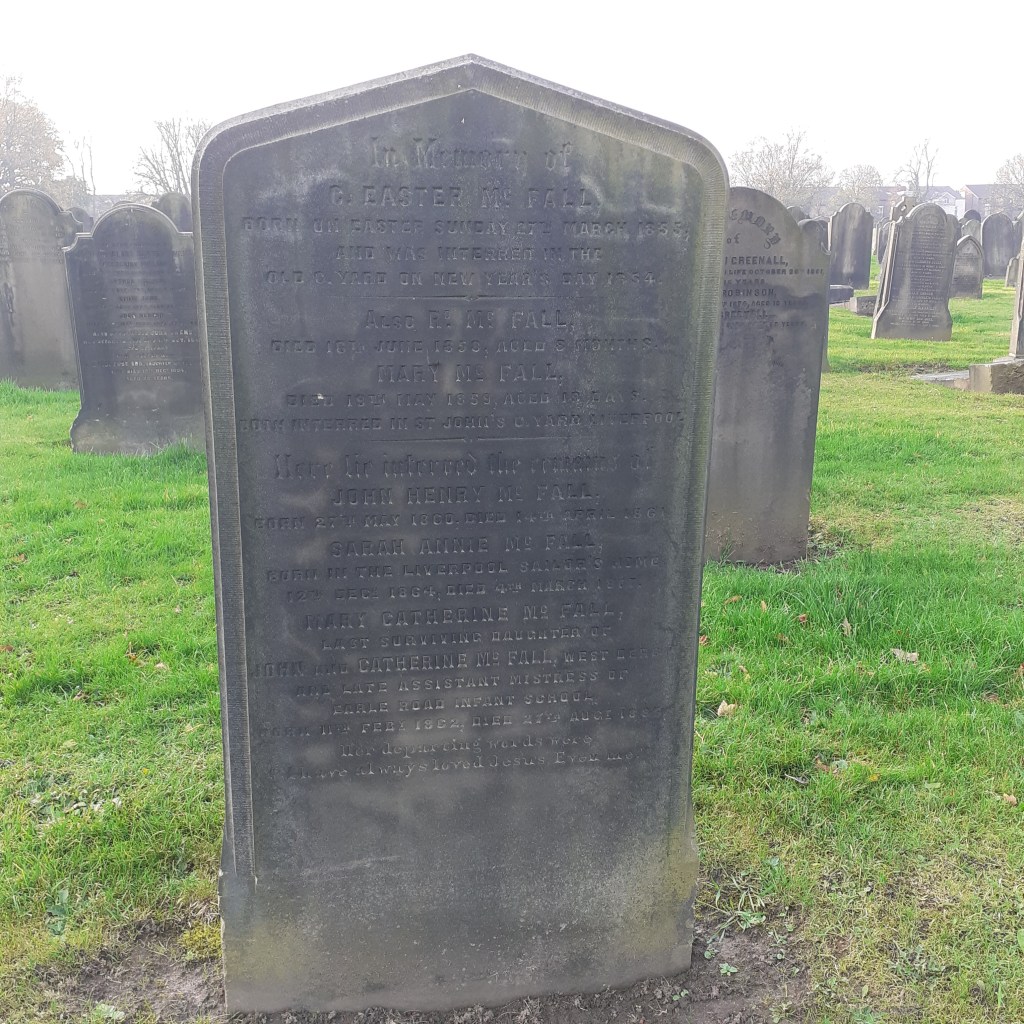
A follow-up walk takes us to Toxteth Park Cemetery and the family grave is found. Here additional children are memorialised – Easter (born on Easter Sunday March 1853 and died after only 9 months), Richard (b. 1858 died after 8 months), Mary (b. 1859 died after 19 days), John Henry (b. 1860 died 11 months) and Sarah Anne (b. 1864 died aged twelve). We are also informed that Mary Catherine, who lived to the age of thirty-three, was an assistant mistress at Earle Road Infant School. We are told that her last words were, “I have always loved Jesus. Even me.”
Having followed John through to his end, through the children it was possible to trace backwards too, to get an idea of how John came to be living in Bankfield Road. In 1881, the year before the inscription, the family live around the corner in 10 Quarry Road with John employing three men and one boy. This was the time of great expansion of Stoneycroft and Tuebrook and presumably there was plenty of available building work in the locality. Two other children are mentioned – Mary at 18, five years older than Samuel and John, two years younger.
In 1871, at the same address, along with the previously mentioned family members there is an older child Thomas (born 1856) who is described as an ‘office boy’.
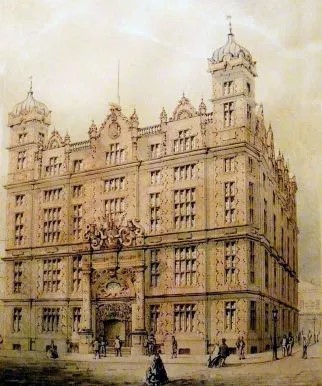
Ten years earlier, the McFalls are in Everton, 145 Field Street. John’s profession is described as ‘Clerk of Works at Liverpool Sailors’ Home’. A short history of the building, which was sited in Canning Place, and the work undertaken there is given by Tom Hutchinson on the ‘Liverpool Ships and Sailors’ website. The Sailors’ Home was built in late 1840s and served the needs of visiting sailors until 1969. In the impressive building (the sketch from the 1852 shows something of its grandeur) sailors could receive board and lodging for a moderate fee. In addition, there was medical provision and facility for educational and spiritual ‘improvement’.
It was demolished in the mid-1970s.
John’s role was significant in that, for all its external attraction, the interior workings had been badly neglected during the building process and it was beset with problems. This resulted in major difficulties over heating and there was a major fire in 1860. John’s work at the Home was appreciated. The Maritime Museum holds a copy of a letter praising his work as clerk of works, dated 5th August 1862.
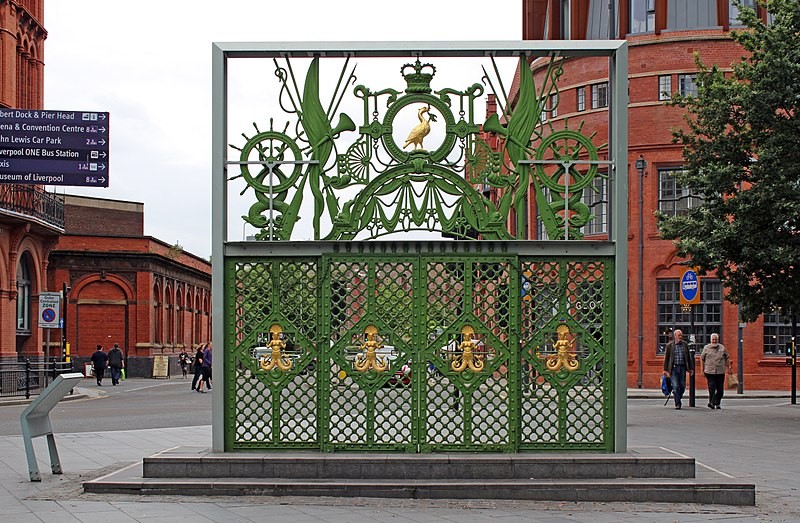
The gates that we are all familiar with on Paradise Street are an example of the challenges created by lack of care in the construction phase of the building. They were not hung correctly, had to be forcibly opened and were the cause of the crushing and killing of at least two seamen. This monument is one surviving part of the building in Liverpool, others include a liver bird in the Museum of Liverpool. Other elements (e.g. internal railings) were put to good use by Clough Williams-Ellis in Portmeirion.
Stepping back further we find that the McFalls were married in St Augustine’s in Everton on 12th May 1851; two months earlier, the census shows us where they were living. Catherine was with her father, James Murphy, who was a dock worker. They were living in Milk Street, just off Dale Street. She was a dressmaker. John is lodging with his future mother-in-law Margaret and her sister Mary who are both laundresses in Jenkinson Street in Everton. His profession is described as ‘mariner’. Here, then we get an indication of John’s earlier life and an urge to dig deeper rises.
 Stepping Out, Stepping Back, Stepping In