
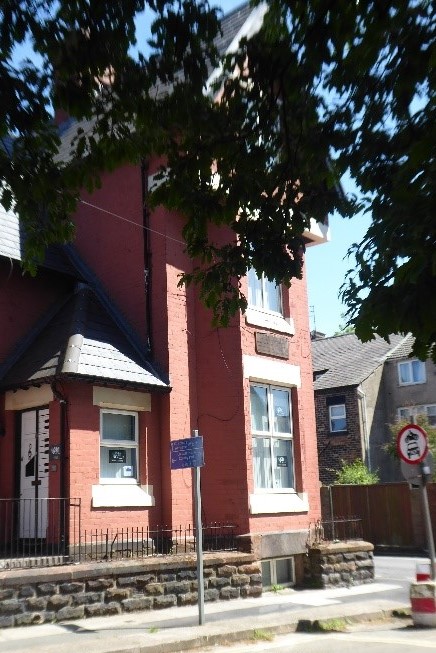
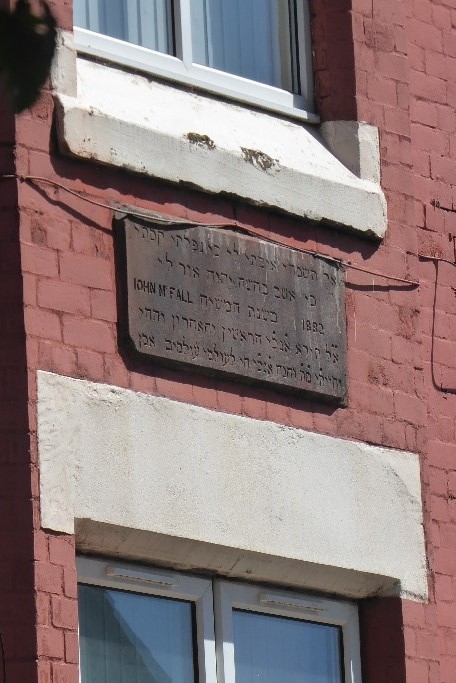
An early lockdown walk took us around our local streets in Stoneycroft. Having wandered up to Queens Drive and along to the Jolly Miller, we returned through Bankfield Park. As we headed towards Russian Drive, our eyes were drawn to a sandstone plaque on the house which is at the corner of Bankfield Road and Quarry Road.
Closer examination indicated that the writing was in Hebrew other than the name of the supposed inscriber and the date erected – John McFall 1882.

Curiosity pricked, a return home and an initial internet search took us to a journal, the ‘Liverpool History Society Newsletter No 23’ from Winter 2008-09 and a request from a reader. Christy McHale had noticed the plaque and was sharing her own research and seeking information about John McFall.
She had sent the transcription to Hebrew scholars in Israel who had identified the first two lines to be from the Hebrew Scriptures, what Christians call the Old Testament:
Rejoice not against me, o mine enemy; when I fall I shall rise; when I sit in darkness, the Lord shall be a light to me.
Micah 7:8
She wondered whether the verse had been chosen as a play on his surname.
The third line was seen to be effectively the writer’s signature:
In 1882, the year of the Messiah, John McFall.
The fourth and fifth lines proved to be more troublesome to the Hebrew scholars who came up with slightly different translations:
Do not be afraid I was dead, but here I am alive for ever and ever. Amen.
and
Do not be afraid, I am (=God) is the first and the last; I raise the dead, and always protect my people.
These verses are, however, very recognizable to those familiar with what Christians call the New Testament. They come from the first chapter of the Book of Revelation, verses 17 and 18.
So, while a first thought might have been that this was something to do with a Jewish household, we have deduced that a Christian (the reference to the year of the Messiah) homeowner has chosen favourite or relevant biblical quotes to adorn the side of their dwelling. However, there are other questions to be asked: Why write out the verses in Hebrew and translate the second quotation from the original Greek to Hebrew? Who was John McFall? What was the significance of the date?
 Stepping Out, Stepping Back, Stepping In